Timeline
Every project I've built, in order. Hover or click a year or a project.Every project I've built, in order. Tap a year or a project.
60projects 25active 2022-2026 13categories
Pick a dot to open a project.
One of my first Python projects from 2022, built when I was just starting to learn programming. Interactive Times Tables is a command-line game that quizzes you on your times tables, tracks your score, and lets you choose which table to practice. I built it to get comfortable with loops, conditionals, and user input in Python. It lives on GitHub as part of my early pythonprojects repository - a snapshot of where I started before moving on to web development.
Tutored KS3 & GCSE Maths and Physics - 10 remote students via GoStudent (year 6 to year 11) and one private in-person year 7 student in Milton Keynes. Weekly sessions with tailored lesson plans for each student. 11 students by the end of the year.


Pick a dot to open a project.
Launched and market tested an online card animation proof of concept. Think Moonpig but for virtual cards - I designed and hand-drew every card, then ran $1 Facebook ad campaign to put my first project out there.
Can you beat the AI, or will it guess your thoughts? A UI consisting of yes/no buttons. You think of any thing and the AI will attempt the narrow down the answer in 20 questions.

Python and Pygame solar system. Eight planets orbit a central sun using real gravitational physics, with hover-to-identify and planet-specific sizes and colours.
Arcade shooter game inspired by Space Invaders.
A simulation of Conway's Game of Life patterns.

Simulation of Langton Ant's pattern evolution.
I've run YouTube channels across different chapters of my life, each one reflecting what I was into at the time. Jack & Tikita's Travel Vlog was the first - a travel blog I started during my gap year in 2022/23 while backpacking around Asia. I documented the places we visited, the food, the chaos, and the highlights of the trip. It was my first time editing video seriously, using iMovie and later Final Cut Pro. tikitatech launched in 2023 when I started building web apps and wanted somewhere to share them. I posted short demos of projects I'd built - nothing polished, just screen recordings showing what I'd made and how it worked. It was a way of keeping a public record of my progress as a developer. ReVamped with AI came in early 2024 when I got deep into generative AI tools. I used Suno AI, Udio, and Midjourney to create original AI music and reimagine public domain songs with a modern feel. It was a creative experiment more than anything - exploring what was possible with the new wave of AI music generation. daedatech is the current chapter - long-form HubSpot content built around the search queries operators are actually typing. This is what I'm currently growing.
Pick a dot to open a project.

Developed a full-stack application that scrapes property listings from Rightmove, allowing users to explore and compare properties in any desired location. Built with Puppeteer, Cheerio, TypeScript and Bun, the app gathers comprehensive property data and displays it in a user-friendly interface using React.js, DaisyUI and TailwindCSS. Integrated interactive comparison features with clickable options, enabling users to analyze properties based on key factors. Visualized data insights with Chart.js for a seamless, data-driven experience.
Emoji Translator is a web app that converts English sentences into emoji sequences. Built with a Python backend using Beautiful Soup to scrape and structure emoji definitions from Unicode data sources into a searchable CSV dataset, paired with a JavaScript frontend that maps words and phrases to their closest emoji match in real time. The translator handles synonyms, common slang, and multi-word expressions to produce surprisingly accurate emoji translations. Originally built as a fun experiment in web scraping and natural language matching, it demonstrates practical use of data extraction pipelines feeding into an interactive UI.
Ending the endless Uber Eats scroll! Hooked up the Google Maps API allowing you to have a random search for food nearby
Scraped article titles and captions for upskilling in structured data extraction.
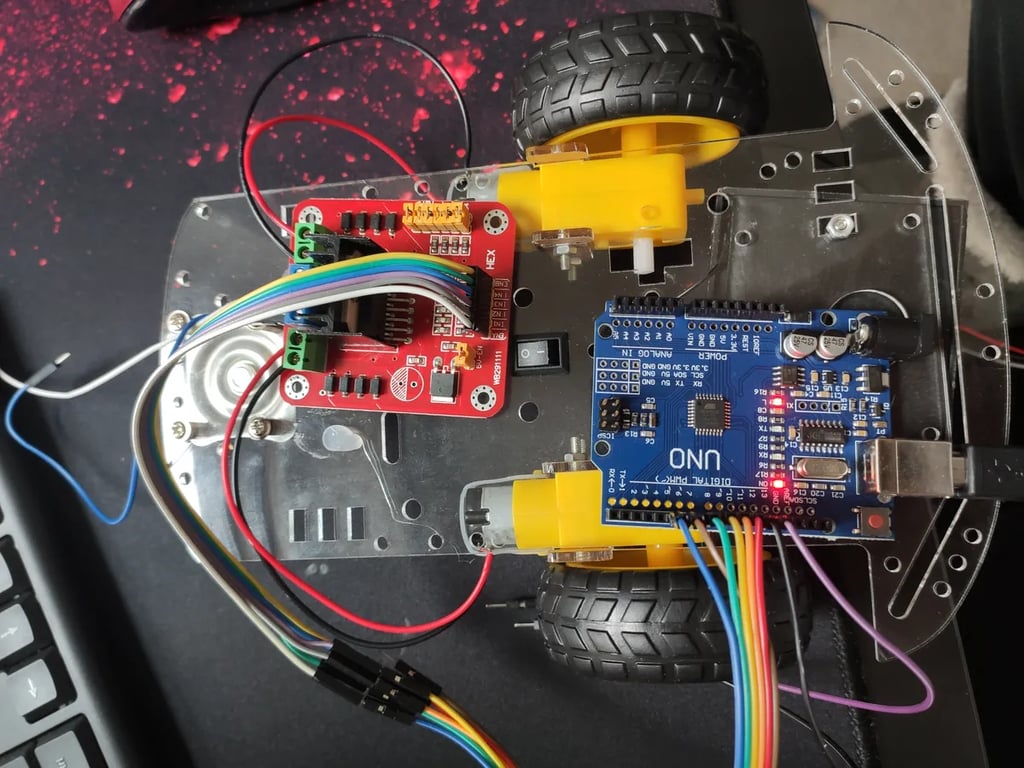
Built during my Manchester Uni foundation year with the robotics society, and I got it moving. Started on the university's Arduino in C++, then attempted a Raspberry Pi version independently in Python. Both the Arduino and the old Raspberry Pi eventually broke, which ended the project, but I learned loads.

I got to take part in a Hackathon with UniCSHackathons! It was an awesome experience and my team were amazing to work with - we created a site where you can choose between 3 versions of real news articles, aimed at primary, secondary and adult ages to learn about current space events! The articles were scraped using puppeteer/cheerio from spacenews.com then stored on a PostgreSQL database using a Django backend, before being sent to Google's Gemini LLM to create the new content. The new articles were displayed with a React and typescript frontend!

Scraped Wikipedia for visa requirements for a fellow indie hacker’s web app.
Extracted movie metadata to practice data extraction and cleaning for film databases.
Scraped Letterboxd for film reviews and ratings to experiment with dataset formatting.
Freelancer Scrape is a Python web scraper that extracts job listing data from Freelancer.com using Beautiful Soup for HTML parsing. The script collects structured fields including job title, description, required skills, budget range, bid count, and posting date, then exports everything to a clean CSV file for analysis. Built to explore the freelance job market and identify trending skills and pricing patterns across categories like web development, data science, and design. This project was a hands-on exercise in structured data extraction, handling pagination, and cleaning messy real-world HTML into usable datasets.

PerAnder ArtWorks is the platform where Maria brings her love of the captured imagery-art that speaks to you, to the public. E-commerce frontend site for photography art. Migrated to Umbraco for client-managed updates.
Website offering custom web scraping services, deployed to a k3 cluster. Upwork contracts from the same period: Web Scraping eAIS UK, Web Scraping FAA.gov, PDF Mapping Project.
Mapped spreadsheet data to corresponding content in a numbered PDF to extract and match page numbers for each row
First UpWork contract. Scraped FAA.gov aviation data, cleaned and delivered in CSV format. Review (5 Stars): Tikita did the task exactly as I wanted and she did it quickly. She communicated well and our intermediate check ins were helpful. Would definitely hire again.
Mapped spreadsheet rows to corresponding PDF content, extracting page numbers for each row.

Knows everything about Stardew Valley! Ask any Stardew Valley question and get instant answers - temporarily offline after OpenAI took it down. Reached 1K chats and 10 reviews (4.2 star rating) before going down. Built with Puppeteer and Cheerio for scraping the Stardew Valley Wiki, TypeScript for structuring data into markdown files, and sklearn for clustering content into 9 categories to speed up responses.
Our wishlist app integrates seamlessly with your store. Customers can save favourite products or variants for later, view all saved items in one place, and add them to cart when ready. Shoppers can use a floating button with a side drawer or a navigation link with a dedicated page, and you can customise button and icon colours to match your store's branding. Guest shoppers are prompted to log in or create an account to keep their wishlist, helping you capture more sign-ups and repeat sales.

Daeda Tech's marketing site, daeda.tech - the front door to our HubSpot apps. It's where operators discover what we build, read the docs, and book a demo, and it's the growth engine for Daeda AI. I own it end to end: design, build, copy, and search.
An experimental Shopify store selling print-on-demand physics-themed AI apparel (TheoryAndThread) - sublimation patches. Used it to test the Daeda Wishlist app in a real merchant context and explored automation workflows connecting customer activity to social posts and sales data pipelines in Google Sheets. Didn't get any sales.
Pick a dot to open a project.

I saw a store owner talking about copying their sales into a Google Sheet by hand every day, so I built a Shopify app to do it for them. You sign in with Google inside the Shopify admin, pick the sheet you want, and a scheduled job sends your daily sales stats into it. That includes order totals, average order value and percentage changes, and zero-sales days too, so the history has no gaps. It worked end to end, but I moved away from Shopify soon after, so I never released it.

Five custom GPTs shipped across two months in early 2025. Shopify wasn't working out and GPT development looked like the thing to go all in on, so I built a spread of them to prove I could. The bet didn't pay off and I soon switched to working on HubSpot, but the GPT Actions and function calling work fed straight into everything after it. Quacksheet Financial Advisor analyses data straight from Pipedrive files, with a duck twist. Connects to an external server via GPT Actions for practical financial analysis. Not currently public. Page Insights turns technical site metrics into plain English, reading 40+ performance metrics including load times, JavaScript usage and visual stability, and handing marketers recommendations they can act on without a developer. Not currently public. Learning Roadmap turns scattered tutorials into phase-based skill plans with clear milestones, pulling resources from arxiv, gutendex and openwhyd. Recipe Rummage finds recipes from ingredients you already have, cutting food waste and the last-minute shop. Built on GPT Actions and the Spoonacular API with structured outputs. 40+ chats. Dev Jokes debugs your day with laughter, one function call at a time, hooked up to JokeAPI.
I built a new feature for stores to help them pick up right where they left off! Now, when someone explores a site and then returns to the home page, they’ll see up to 5 of their recently viewed products - right on the page.
A custom tool that performs entity disambiguation and sentiment analysis on media articles. This project involved using Hugging Face transformer models for entity recognition and sentiment detection as well as creating a Streamlit interface for easy article submission and instant analysis results.
Faceless AI video was everywhere in early 2025, so I ran two accounts across six channels to see whether the format actually worked. Pick Your Potion Realm took the fantasy and magic niche, Much Ado About Choosing took Shakespeare and dark academia. Both ran a pick-one format: a question and a set of options. Stills came from Flux Schnell, video from Hailuo and Runway on Replicate, and everything was cut in Final Cut Pro. 25 shorts went out over two months. The result: the best performers passed 2K views each, and subscribers mainly grew on insta to a couple hundred.
Five custom GPTs, one per HubSpot hub, each trained on scraped HubSpot Community Forum content so the answers come from what operators actually ran into rather than the docs. Sales & CRM was the one that landed, passing 400+ chats; the other four never found the same audience. All five are on pause because of OpenAI's developer experience, and I'd like to rebuild the idea on a better platform. Sales & CRM gives contextual advice on deals, pipelines and CRM setup. Marketing and Content surfaces tips buried in the forums. Customer Success and Service connects tickets, customers and churn. Commerce breaks down HubSpot Commerce features for merchant adoption. RevOps and Operations handles lead routing logic and operations questions.

A HubSpot app that links CRM records automatically from custom rules, so a rule like "associate every contact at a company with that company's deals" runs on its own instead of someone linking records by hand. Jack and I split the build. He built the rules engine; I built everything around it: - Pricing and sign-in: the plans and the HubSpot sign-in flow. - Loop detection: catches rules that would trigger each other forever, before they're saved. - The interface redesign: the rule builder, field picker and filters. - Load testing: scripts that generated test records and webhook traffic, to prove it held up under real portal volumes. I also ran the outreach: short, personal messages written one at a time to people who'd mentioned the exact problem the app solved. We sunset it in 2026 to focus on our newer apps.
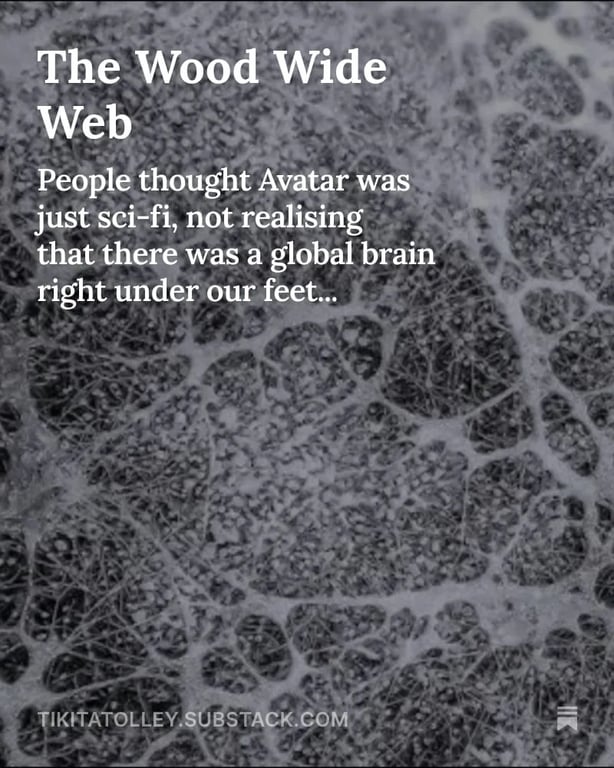
I run two Substacks exploring different sides of the same curiosity. Curious Descent is where I wander down the philosophy rabbit hole. Building a business has turned my understanding of the world upside down and surfaced existential questions I wasn't expecting. The more I learn about this weird and wonderful world, the more questions rise to the surface - so I write to think through them instead of letting them wander endlessly in my head. These pieces tend to focus on philosophy, with hints of history and biology throughout. Code & Solder documents the technical journey - building apps, starting hardware projects, and navigating the new era where AI has transformed my process from writing code to orchestrating systems. My first Shopify app took 3 months to build; now I can ship a new site, Chrome extension, or HubSpot app in days. There has never been a time with more opportunity than right now.
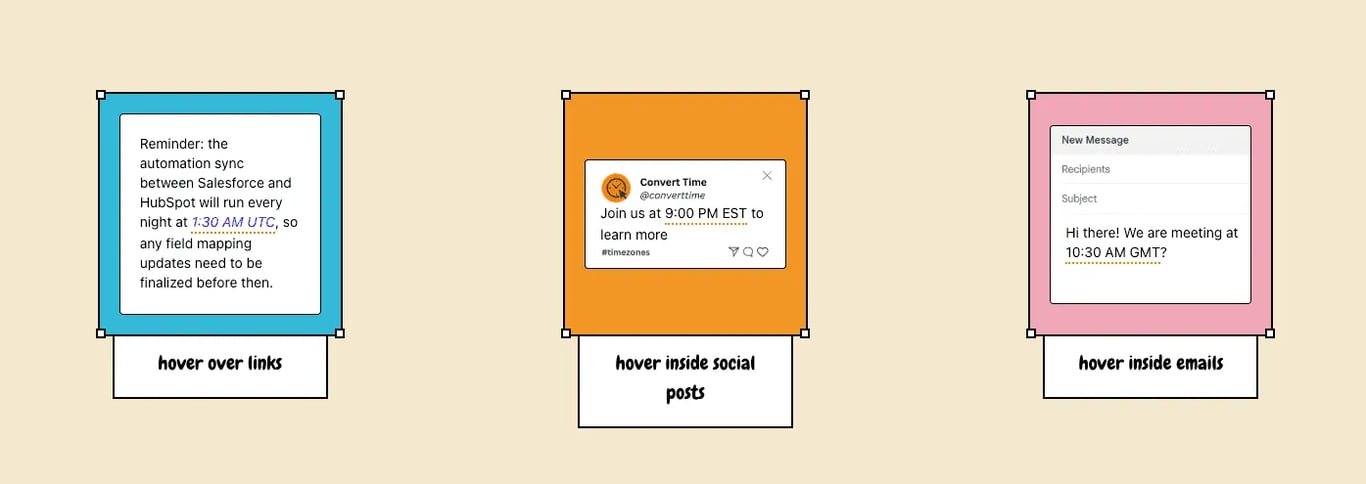
Convert Time is a Chrome extension I built to solve a problem I kept running into as someone who works with people across multiple time zones. It finds times on whatever webpage you're looking at, underlines them, and shows the conversion in your local timezone in a tooltip when you hover. It supports 35+ timezones, is free to install, and works entirely in the browser with no account required. I built it in JavaScript using Chrome's extension APIs, and it has 436 installs. The idea came from constantly doing mental timezone maths during calls and realising the answer should just be there on the page, where the time already is.

HubSpot workflow app for formatting and verifying phone numbers. Format Phone Number (free, unlimited) standardizes numbers across 245 countries into E.164, international, national, digits-only, and RFC3966 formats. HLR Lookup confirms whether a phone is actually switched on and connected to a mobile network by querying the Home Location Register in real-time. Automatically populates HLR status, syntax check, and formatted number properties.
Pick a dot to open a project.
The secure layer between your AI and HubSpot - safely reads from and writes to your portals, with a human approving every write. Connect Claude or ChatGPT, ask for a change, review the plan it drafts, and approve it before anything runs. Audit portal health, data quality and association gaps in plain English. Run bulk operations across multiple managed portals, and build segmentation lists, workflows and live dashboards from a single conversation - complete systems in minutes, not a two-week project plan. Daeda Tech's flagship product. Jack builds out the project, I focus on distribution (YouTube, LinkedIn, AEO/SEO).

Add a customizable glowing circle that follows your mouse cursor across every website. Perfect for screen recordings, presentations, or just adding some personality to your browsing. Features 5 neon colors, one-click toggle, and settings that sync across all tabs.

A curated list of awesome MCP servers for HubSpot. Discover community-built servers that extend AI assistants with HubSpot CRM capabilities.
HubSpot app that eliminates messy CRM data caused by manual text inputs. Scans your unique record values and lets you flip a switch to turn any text property into a dropdown - no more 'New York' vs 'NYC'. Works across contacts, companies, deals, and tickets.
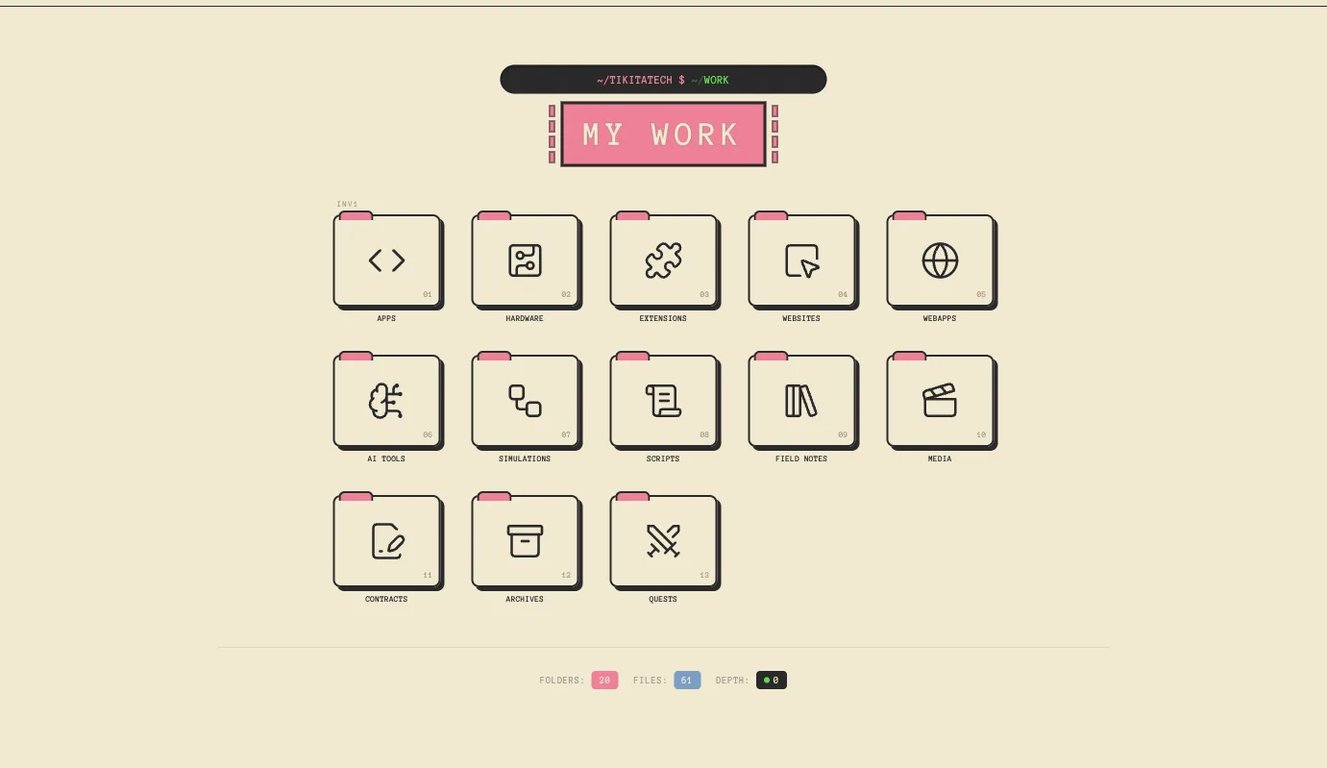
My personal site - the home for everything I make and think about. HubSpot apps, Chrome extensions, hardware builds, AI tools, writing and side projects all live here in one place, in a bold neobrutalist design. It's where I show what I've shipped, what I'm reading, and the lessons I keep coming back to.
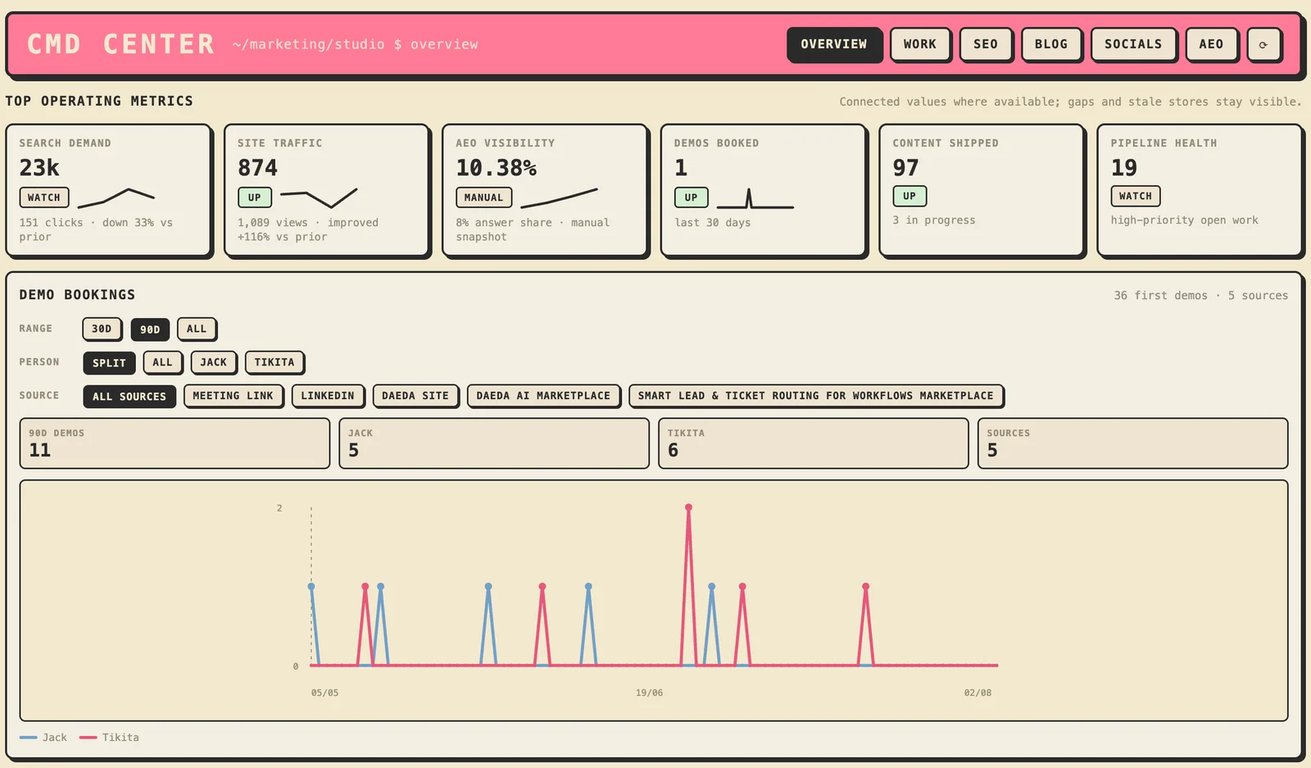
The command center for running Daeda - one internal app where every marketing and business signal lives in one place and the AI has full context. It grew out of a deliberate choice to build an internal OS instead of buying tools, and it replaced a stack of scattered docs, spreadsheets and subscriptions. How It Works The loop is capture, file, surface, decide, express, and each area owns one stage. Scheduled fetchers pull from search consoles, site and product analytics, page-speed, CRM, video and the forums, each writing to a single structured store. Every room is a view over that one store. The Rooms - Overview: the morning read - top operating metrics across search, traffic, answer-engine visibility, demos, content and pipeline, with a what-changed feed and a needs-attention list. - Work: the desk - a weekly block plan, a worklog of done work, and one ranked next-best-work queue. - SEO: a search operating dashboard - performance, health, growth and tracking on live search-console data. - AEO: answer-engine visibility - share of voice, AI citations, the prompts we get cited in, and a recommendation queue. - Socials: community listening and video tracking, powered by Community Radar. - Blog: the writing room - a content pipeline and an editor that writes straight to the real markdown, previewed against the live stylesheet.
The system I run my life and work from. It keeps track of what I'm building, reading and watching, the people I'm talking to, my health and even my dreams, and every day it pulls in my social stats so I can see how each video is doing. Once a month it wraps the month up, and a scheduled review looks back across everything and points out connections I hadn't noticed.
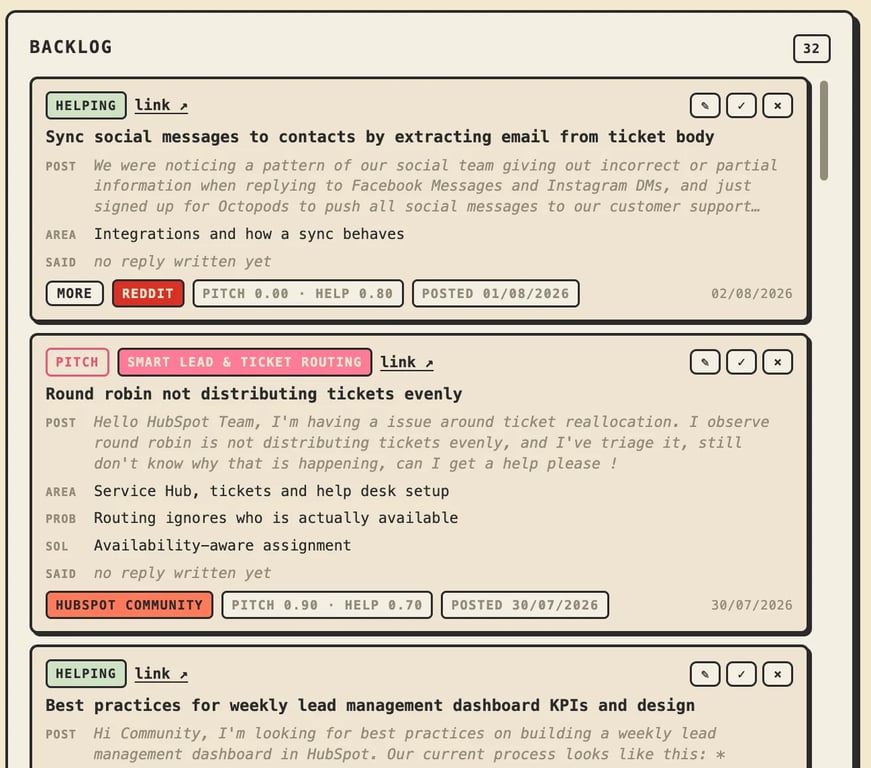
An automated daily sweep of the forums and social channels where our buyers already are - Reddit and the HubSpot Community - that surfaces the threads worth answering and turns recurring pain into a content backlog. The radar then scores them. What It Does - Sweep: a scheduled pull ingests forum and community threads relevant to our apps and category. - Triage: a model filters down to the most relevant threads for our knowledge area and apps before they land as a card in a reply queue. - Themes: the same threads are counted - topics, problems and solutions ranked by recurrence, anything recurring three times or more flagged, each expandable to the threads behind it. - Promote to content: a recurring theme can be promoted by hand into the content pipeline, carrying its evidence with it, so the blog gets written from measured demand rather than guesses.
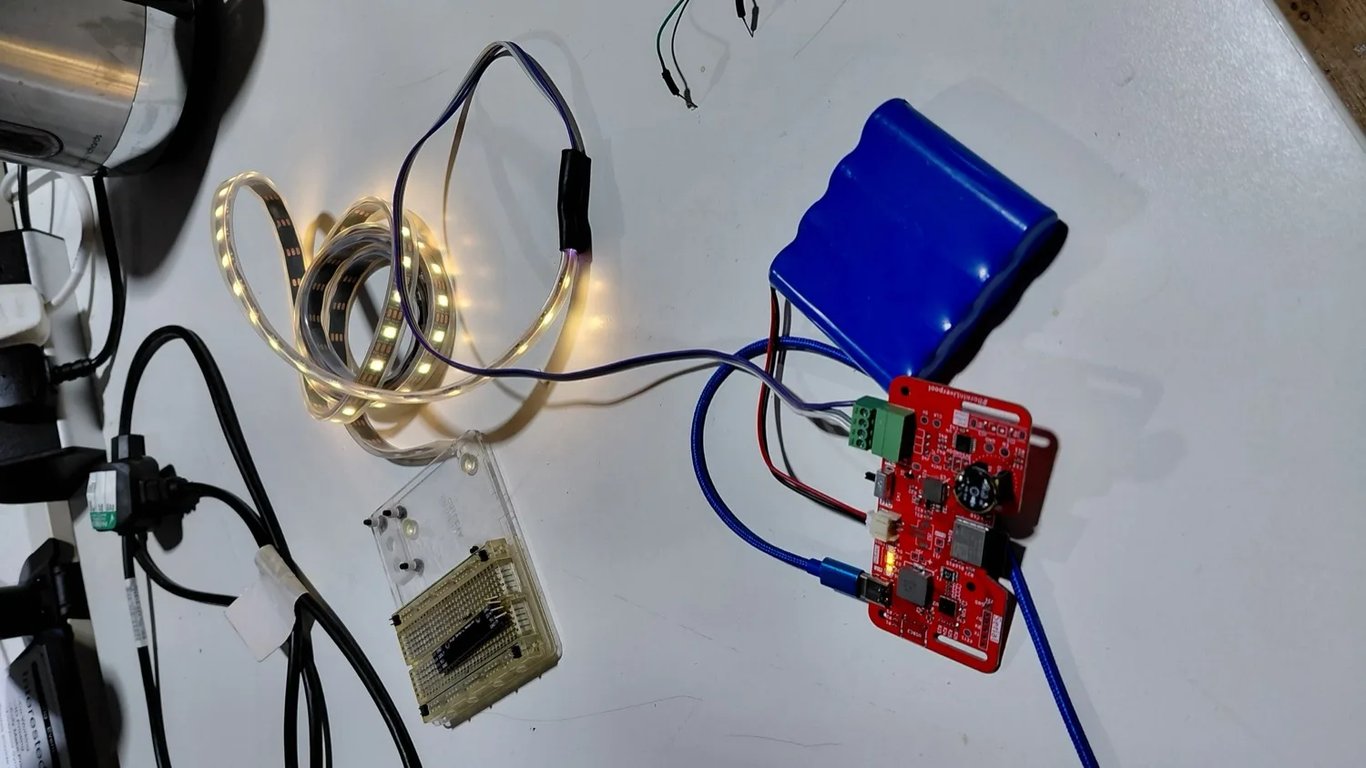
My first hardware build. An ESP32 driving a WS2812B addressable RGB strip, lighting individual pixels and cycling them through colours on a timer - the starting point for getting FastLED talking to the panel before doing anything more interesting with it. The ESP32 is a custom board made by someone at DoES Liverpool with the LED connector built in, so 5V, ground and data all come off a single plug. Data sits on GPIO5 and brightness is capped at 50/255. It started out as a sound-reactive build, but the board's microphone turned out to be digital and I ran out of time on the digital-to-analogue side, so that path is still sat commented out in main.ino.
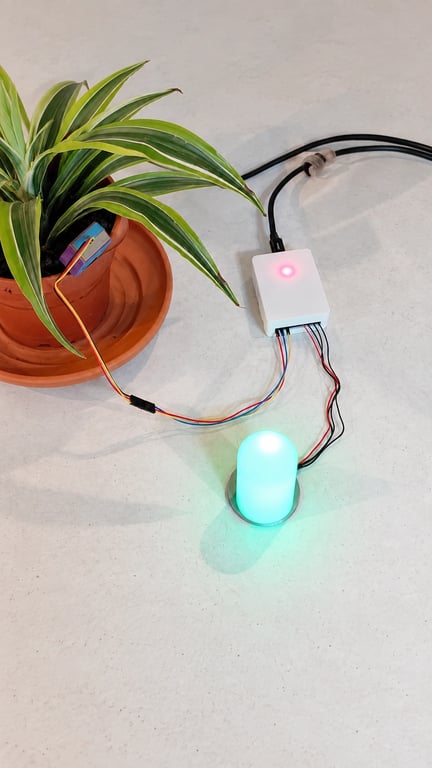
An ESP32 plant monitor with a soil sensor, RGB status lamp, custom enclosure and companion PWA.
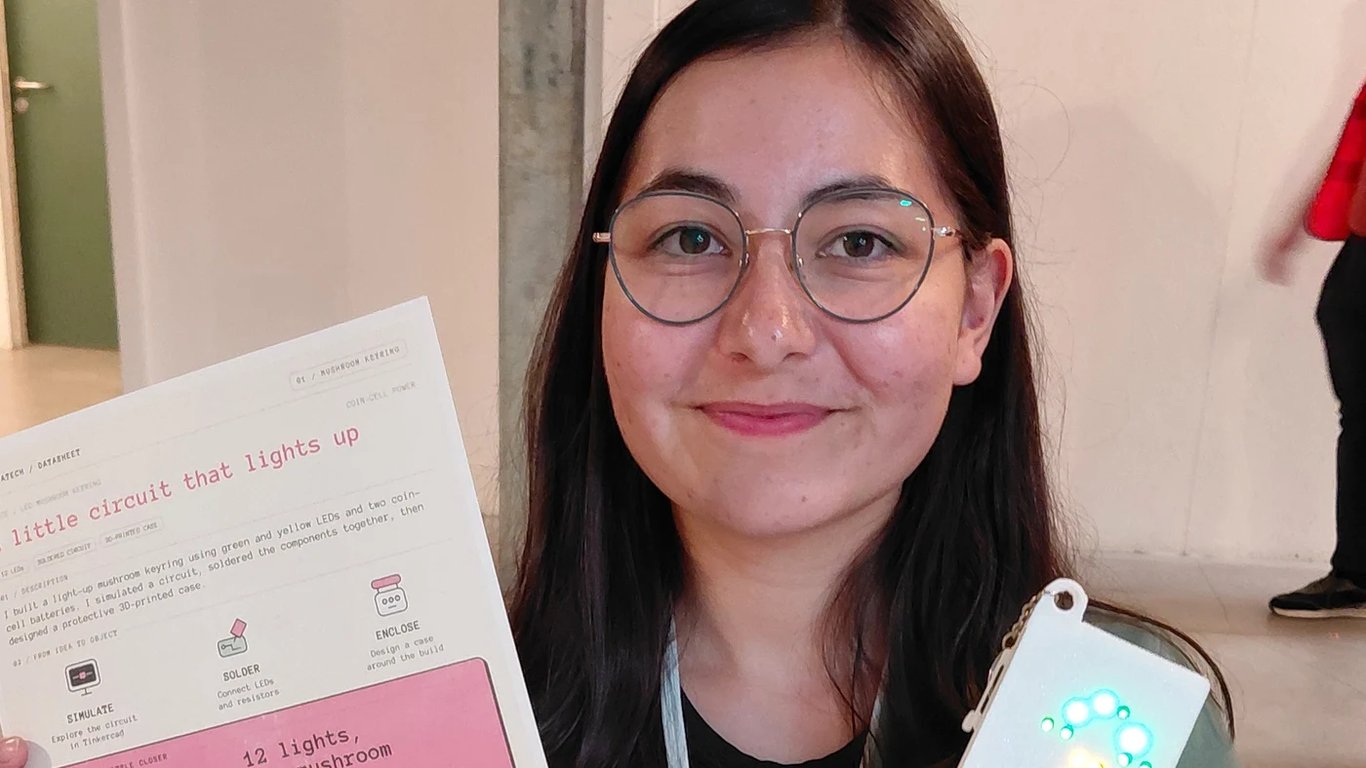
A hand-soldered LED mushroom keyring with a custom 3D-printed enclosure, built for Liverpool MakeFest.
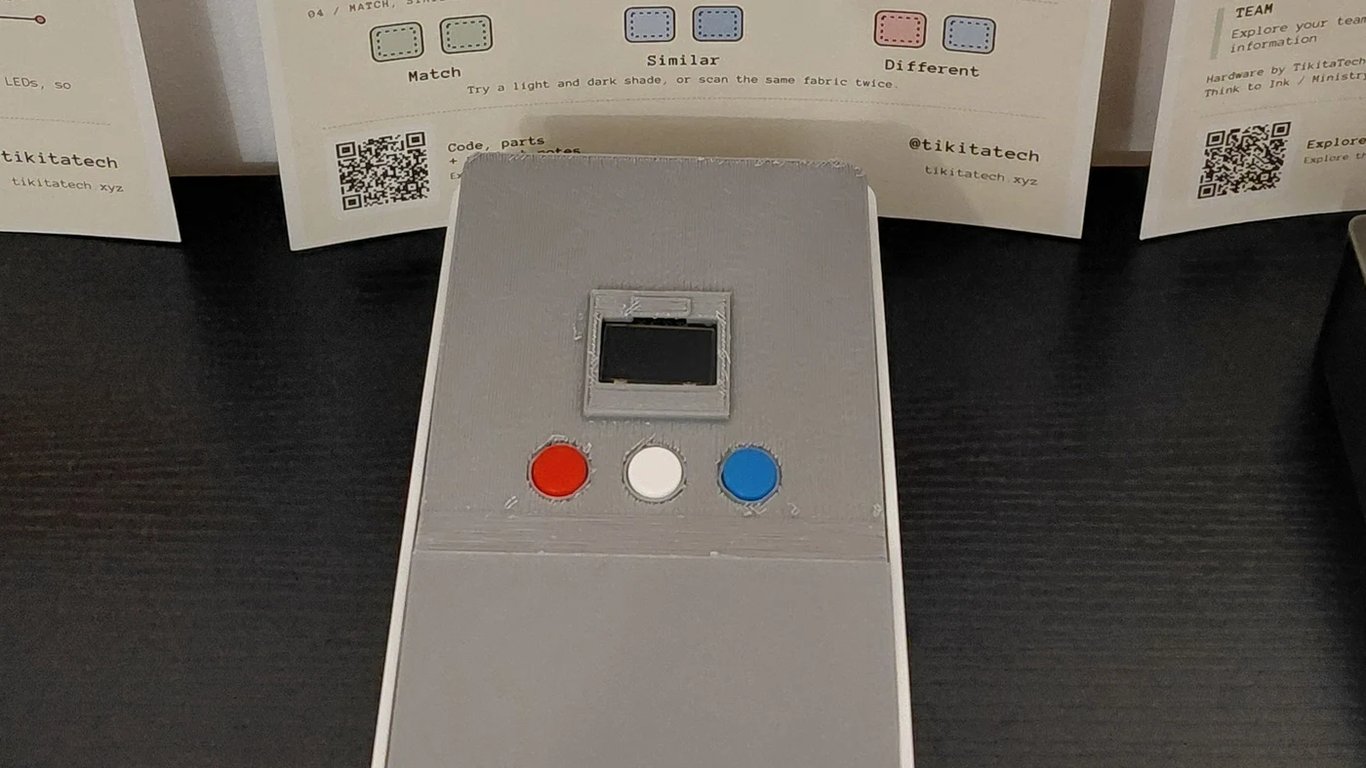
A handheld ESP32-S3 scanner that compares two fabric colours and shows the result on an OLED.
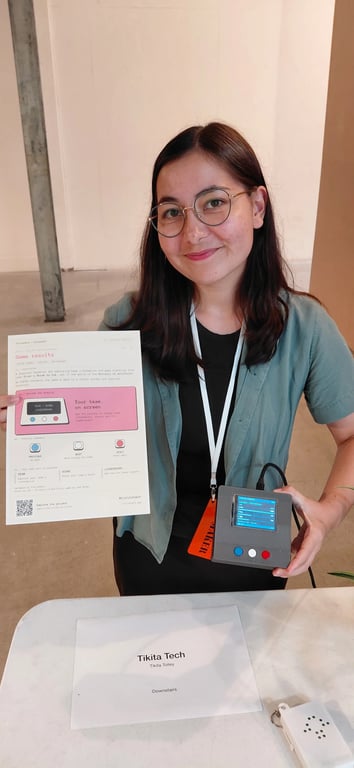
An ESP32 Analysis Terminal with a colour screen and physical controls for exploring game scores and standings.

Four working electronics and 3D-printing projects brought to Liverpool MakeFest 2026.
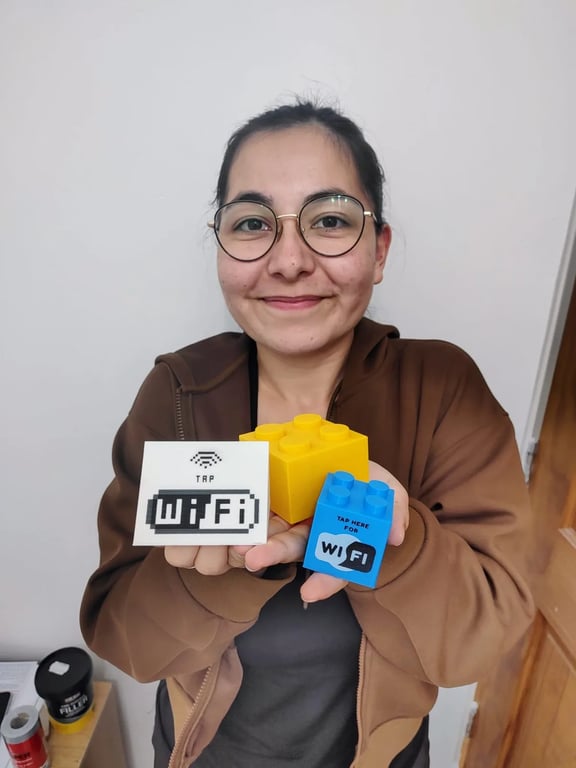
Small 3D-printed builds from teaching myself Onshape: a pixel-art Wi-Fi prism and blocks with NFC tags inside.
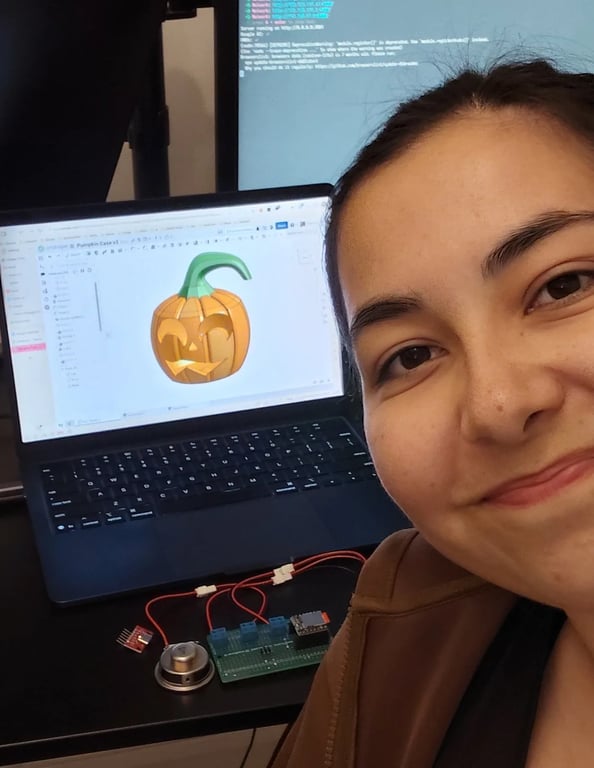
A 3D-printed Halloween pumpkin with an ESP32-CAM that spots people and shouts BOO! at them.