LED Blink
Tech Stack
Links
About
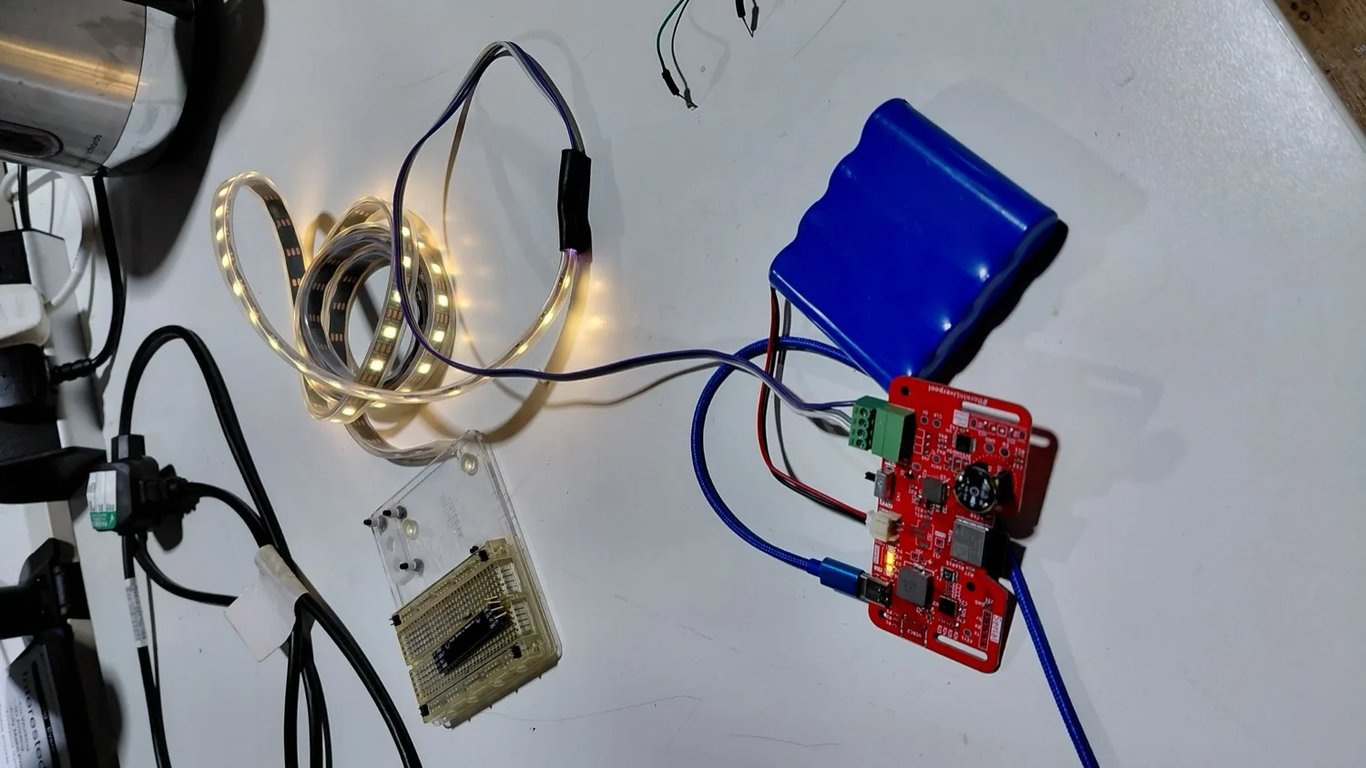
My first hardware build. An ESP32 driving a WS2812B addressable RGB strip, lighting individual pixels and cycling them through colours on a timer - the starting point for getting FastLED talking to the panel before doing anything more interesting with it. The ESP32 is a custom board made by someone at DoES Liverpool with the LED connector built in, so 5V, ground and data all come off a single plug. Data sits on GPIO5 and brightness is capped at 50/255. It started out as a sound-reactive build, but the board's microphone turned out to be digital and I ran out of time on the digital-to-analogue side, so that path is still sat commented out in main.ino.
Discussion & Feedback
Have questions about this project? Built something similar? Share your thoughts!
(Requires GitHub account to comment)
Related Projects
Smart Plant Moisture Monitor
A finished ESP32 plant monitor with a capacitive soil-moisture sensor, a red, yellow and green status lamp, and an installable pixel-art PWA. The final build uses soldered electronics inside a 3D-printed controller enclosure and was exhibited at Liverpool MakeFest 2026. Project materials cost £8.91.
Analysis Terminal
A physical ESP32 game module built for Think to Ink. Entering a player ID on the companion page sends the corresponding team to the terminal, where three physical buttons browse score, rank, games played, wins and league standings on a 2.8-inch colour display. The finished build uses soldered electronics inside a custom black and grey PETG enclosure and was exhibited at Liverpool MakeFest 2026. Project-specific materials cost £18.93.
Fabric Colour Sensor
A handheld fabric scanner that uses an illuminated GY-33 TCS34725 sensor to compare two colour samples. An ESP32-S3 averages ten readings per scan, then shows the RGB values and a Match, Similar or Different result on a small OLED. I moved the working prototype onto two soldered perfboards and built a four-part enclosure for Liverpool MakeFest 2026. The electronics worked throughout the event, while the enclosure needed two zip ties to keep its front and rear securely closed.