Analysis Terminal
Tech Stack
Links
About
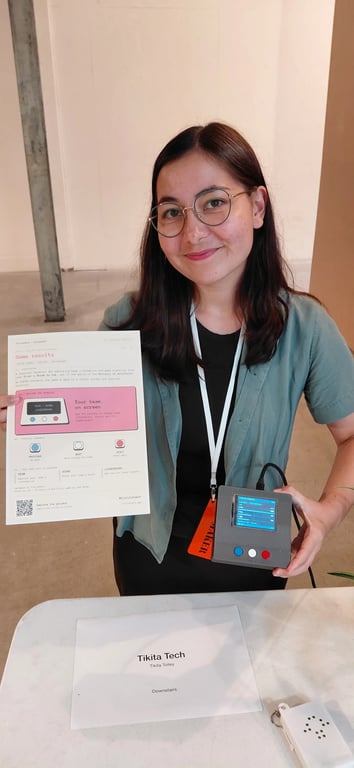
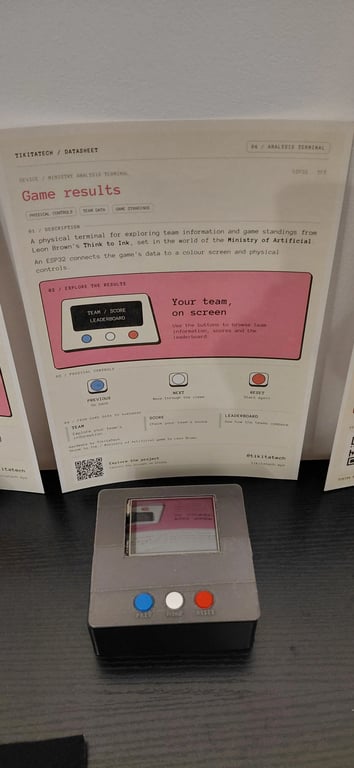
A physical ESP32 game module built for Think to Ink. Entering a player ID on the companion page sends the corresponding team to the terminal, where three physical buttons browse score, rank, games played, wins and league standings on a 2.8-inch colour display. The finished build uses soldered electronics inside a custom black and grey PETG enclosure and was exhibited at Liverpool MakeFest 2026. Project-specific materials cost £18.93.
Phone-to-terminal handoff
A passive NFC tag opens the companion page. Entering a player ID there selects the corresponding team on the physical terminal.
Physical results browser
The terminal presents score, rank, games played, wins and league standings on a 2.8-inch ILI9341 display. Blue and white buttons move between views, while the red button resets the session.
Finished electronics
An ESP32 development board and display sit on the main soldered perfboard, with the three controls on a separate button board. Socket headers keep the controller removable for maintenance.
Compact enclosure
The black base and grey lid measure 114 x 110 x 44 mm and use 89.05 g of PETG. The enclosure cost £3.12, bringing project-specific materials to £18.93.
Build Timeline
Display and controls planned
Defined the five results views and the three-button navigation for the physical terminal.
Terminal and companion connected
Built the ESP32 interface and connected the browser companion so entering a player ID selects the team shown on the terminal.
Final hardware assembled
Finished the soldered main and button boards, then fitted them into the printed enclosure with the display and NFC tag.
Exhibited at Liverpool MakeFest
Visitors used the finished terminal to move through game scores and standings with the physical controls.
Discussion & Feedback
Have questions about this project? Built something similar? Share your thoughts!
(Requires GitHub account to comment)
Related Projects
Smart Plant Moisture Monitor
A finished ESP32 plant monitor with a capacitive soil-moisture sensor, a red, yellow and green status lamp, and an installable pixel-art PWA. The final build uses soldered electronics inside a 3D-printed controller enclosure and was exhibited at Liverpool MakeFest 2026. Project materials cost £8.91.
Fabric Colour Sensor
A handheld fabric scanner that uses an illuminated GY-33 TCS34725 sensor to compare two colour samples. An ESP32-S3 averages ten readings per scan, then shows the RGB values and a Match, Similar or Different result on a small OLED. I moved the working prototype onto two soldered perfboards and built a four-part enclosure for Liverpool MakeFest 2026. The electronics worked throughout the event, while the enclosure needed two zip ties to keep its front and rear securely closed.
LED Blink
My first hardware build. An ESP32 driving a WS2812B addressable RGB strip, lighting individual pixels and cycling them through colours on a timer - the starting point for getting FastLED talking to the panel before doing anything more interesting with it. The ESP32 is a custom board made by someone at DoES Liverpool with the LED connector built in, so 5V, ground and data all come off a single plug. Data sits on GPIO5 and brightness is capped at 50/255. It started out as a sound-reactive build, but the board's microphone turned out to be digital and I ran out of time on the digital-to-analogue side, so that path is still sat commented out in main.ino.