Hardware Projects
documenting my progress - just starting out and i've got a lot planned
ESP32 & Physical Computing
Builds
4
Projects so far
Active
1
On the bench rn
Core MCU
ESP32
+ Arduino heritage
Tools
DIY
Breadboards, jumper wires
Current Projects
Smart Plant Moisture Monitor
In ProgressAn ESP32-powered plant monitor that reads a capacitive soil-moisture sensor and turns the result into a red or green status light. I printed a case for the sensor, then designed and printed my own diffusing RGB lamp head on a Bambu Lab P1S. The working breadboard prototype cost £6.80 in project-specific materials.
Mushroom LED Keyring
ShippedGreen and yellow LEDs laid out as a mushroom cap on a mini solderable breadboard, running off two CR2032 coin cells in series with a slide switch for on/off. The LEDs go two in series behind a single 1kΩ resistor, and those six pairs sit in parallel across the rails, so they all light together and a dead LED only takes its own pair out. Designed in Tinkercad first, then soldered up and fitted to a keyring, with the parts coming to £3.80. It doesn't look much like a typical mushroom, but it turns out there is a green-capped, yellow-stemmed one out there - Leotia viscosa, the Jelly Babies mushroom.
LED Blink
ShippedMy first hardware build. An ESP32 driving a WS2812B addressable RGB strip, lighting individual pixels and cycling them through colours on a timer - the starting point for getting FastLED talking to the panel before doing anything more interesting with it. The ESP32 is a custom board made by someone at DoES Liverpool with the LED connector built in, so 5V, ground and data all come off a single plug. Data sits on GPIO5 and brightness is capped at 50/255. It started out as a sound-reactive build, but the board's microphone turned out to be digital and I ran out of time on the digital-to-analogue side, so that path is still sat commented out in main.ino.
Earlier Builds
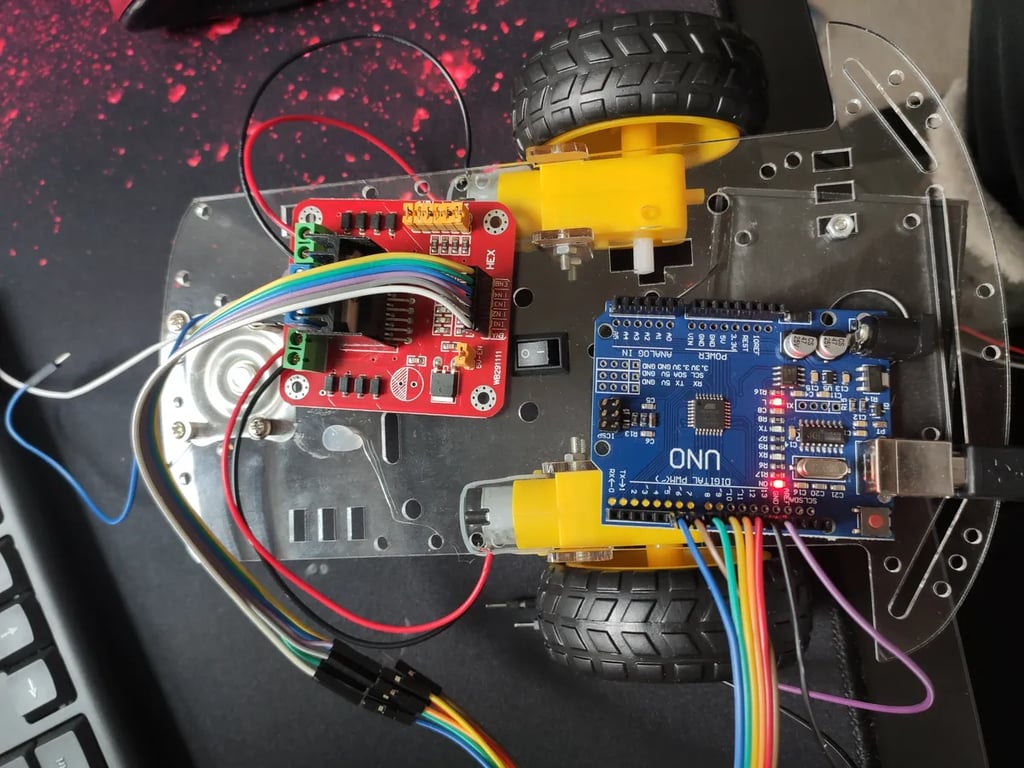
Buggy Robot
ShelvedBuilt during my Manchester Uni foundation year - and I got it moving! Started with the university's Arduino in C++, then attempted a Raspberry Pi version independently in Python. Both the Arduino and the old Raspberry Pi eventually broke, ending the project - but I learned loads.